On nature, nurture and what you show your kids.

I could be a case study for the impact of public art on a child's development. In CultureNOW's October email newsletter they featured the work of James Wines and displayed this image of his "Ghost Parking Lot".
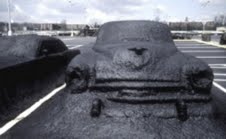
James Wines' "Ghost Parking Lot"
Hadn't I woken one night to a fever and a similar vision? To bury cars under the grass of the Greenway and make it appear as if they were emerging from the tunnel below? Coincidence? Seeing the photo credit (Hamden, CT 1978-2003) it all came back to me. I'd seen "Ghost Parking Lot" many, many times. Mom confirmed: "Yes, you probably saw this as a kid. It was the parking lot where we did our grocery shopping. I'd forgotten about it." I'd forgotten too. We'd left Hamden when I was about 7 and it was now 30+ years later that I recalled the fascinating and horrific site of cars trapped under asphalt.


A similar memory jog occurred in 2010 when Jonathan Lippencot published Large Scale, a history of the Lippencott sculpture production center. Also in the New Haven area, the factory's grounds became an unofficial sculpture park and the site of many of our family walks. Dad tells me I saw versions of Oldenburg's "Lipstick (Ascending) on Caterpillar Tracks", but I can't remember that. I do know I am inexplicably drawn to really, really large sculpture and that it's never big enough. Maybe I am trying to recreate being smaller?


We lived modestly in Hamden. My dad was a newspaper reporter. We drove an old car and grew vegetables in the backyard. It was the 70s and failure and Utopia weren't yet used in the same sentence. And I was impressionable. But what has made the most lasting impact from those days is sculpture, or art in public spaces - especially works that are inextricably tied to their context like "Ghost Parking Lot". I want kids today to have access to the same kind of inspiration right in their neighborhoods. I want to plant in the recesses of their brains an appreciation for the different, the weird, the grotesque, the magical, the place they inhabit, or whatever experiences result from seeing a work of art in an unexpected place. I don't even care if it takes them 30+ years to credit the artist. 


With gratitude to Mr Wines and SITE Architecture and Design for putting me on this path.

Open Studios

The 34th annual Fort Point Open Studios is coming up soon—October 18–20—and I'll be opening my studio to share some new paintings and video. I'm happy to announce that during that time Elisa Hamilton and I will also be presenting Story Lines, an interactive sculpture that encourages viewers to physically and emotionally engage in reshaping our narratives.

FORT POINT OPEN STUDIOS
WHEN:
Friday, Oct 18, 4–7PM
Saturday, Oct 19, noon–6PM
Sunday, Oct 20, noon–6PM

WHERE:
My studio is #A4 in the basement of 300 Summer Street Boston MA 02210. Direct access from A Street, under the Summer St. bridge. Google map: http://goo.gl/maps/ilzs6.

Story Lines will be outside along the Harborwalk.


Nite Life, a Street Piano

I believe we need more moments of spontaneity, joy and surprise in our cities and a project like Luke Jerram’s Street Pianos gives us that opportunity; a chance for us to stop, look each other in the eye, and play. But these kind of lets-all-paint-one-of-the-same-thing projects can really bomb. (Case in point 99% of the Cool Globes installed in Boston.) So when I saw Celebrity Series was bringing the program to Boston I decided I was up for the challenge.


Step one: choose a piano and listen to her story
When I chose my piano, a petite Starck, I immediately saw it as a feminine form and appreciated the lines created by the original designer. It's low to the ground with curves that wrap around the front. It's finished in a deep mahogany.  When I realized this understated lady would have her backside exposed I knew wanted to gussy her up; to touch up her scratches and create something elegant to commemorate the original designer, the women who played on her, and the pluckiness of women of that era who kept their heads up and looked good despite oppression, financial uncertainty and war. Thus the idea of creating an evening dress and accessories for the piano was born. 


Step two: research
Because I’m fresh out of grad school no project goes unresearched. “Nite Life” will be a tribute to the African American women of jazz; in particular the musicians of the late 30s and early 40s like Mary Lou Williams and Carline Ray


Step three: just make it
So I’ve begun sewing, tacking and ripping out seams. It feels like how jazz piano sometimes sounds to me: a bit clanky but somehow it all comes together. Follow the progress on Twitter and Facebook.

unofficially a graduate

Today I completed the last requirement for earning my MFA from School of Museum of Fine Arts, Boston by submitting my Hide:Seek documentation and catalogue.

I'd like to thank my thesis committee (Barbara Gallucci, Nick Capasso and Jeannie Simms) for sharing their wisdom and Joseph Carroll for opening up his gallery to me. And to my family and friends: thanks for playing along with me!


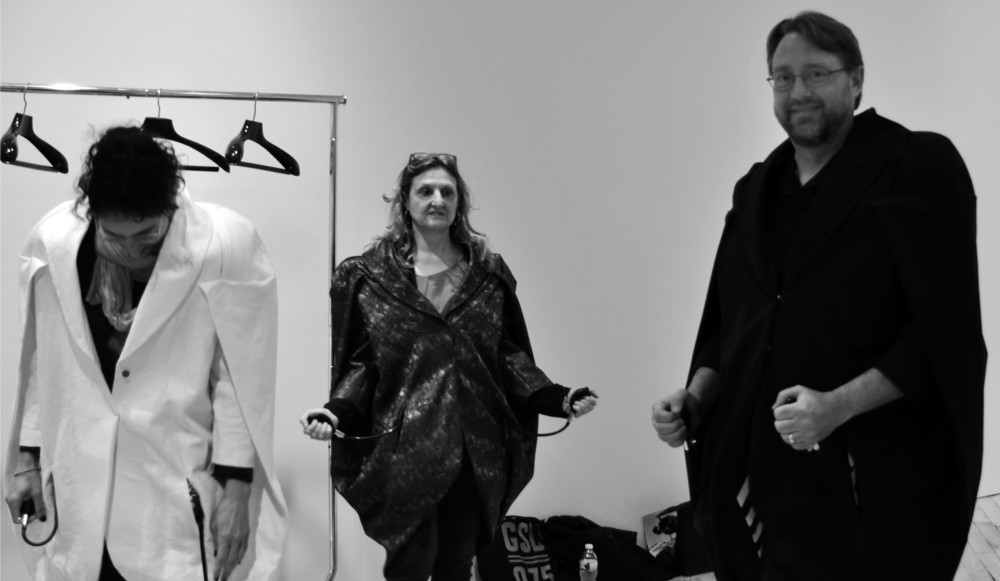
thesis committee or everyday super heroes?

a feminine perspective on Maslow's hierarchy of needs

During the past years of grad school, I’ve been exploring hierarchies and utopias; my role within both (unwitting participant? contributor? creator?); and what happens when upward progression is thwarted. With tongue-in-cheek, I’m designing wearable objects for women that explore the duality of our desire for growth, and our fear of it.

I’m knowingly skirting a line between art and design; between wanting to illuminate the issue and wanting to solve it. And so to help clarify, or maybe further obviate it (I'm still not sure about this), I’ve borrowed a philosophical framework to hang this exploration on: Maslow’s hierarchy of needs.

MASLOW
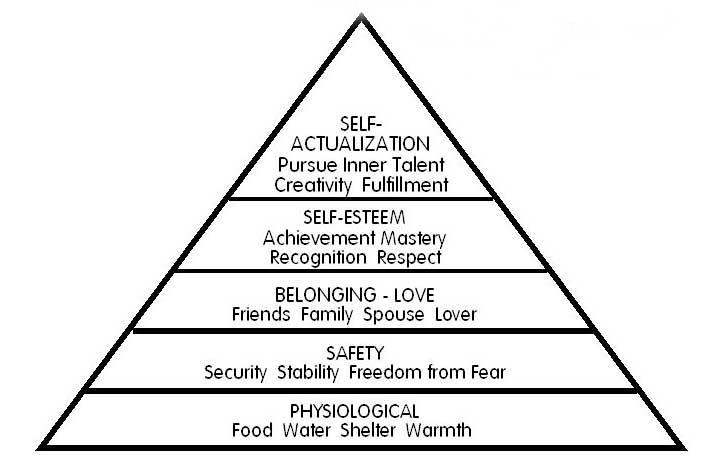
In the mid-fifties Abraham Maslow developed his theory of self-actualization, a process of healthy growth through a never-ending series of free choice situations in which we choose between the delights of safety and growth, dependence and independence, regression and progression, immaturity and maturity.

Safety---<PERSON>--Growth

Maslow identified five levels of need that must be achieved, in order, to reach self-actualization starting with physiological needs and followed by safety, the need for belonging and love, self-esteem, and finally creative self-actualization, or self-development. 


Image from SimplePsychology.org

I’m fascinated with the objects we women employ to give us mastery over each level of need. I'm also interested in what happens when a lower-level need level such as shelter is suddenly missing; when a piece of the pyramid is cut out. Both will be illustrated in my SMFA thesis exhibition May 29-June 1 at Carroll and Sons


It was frigid

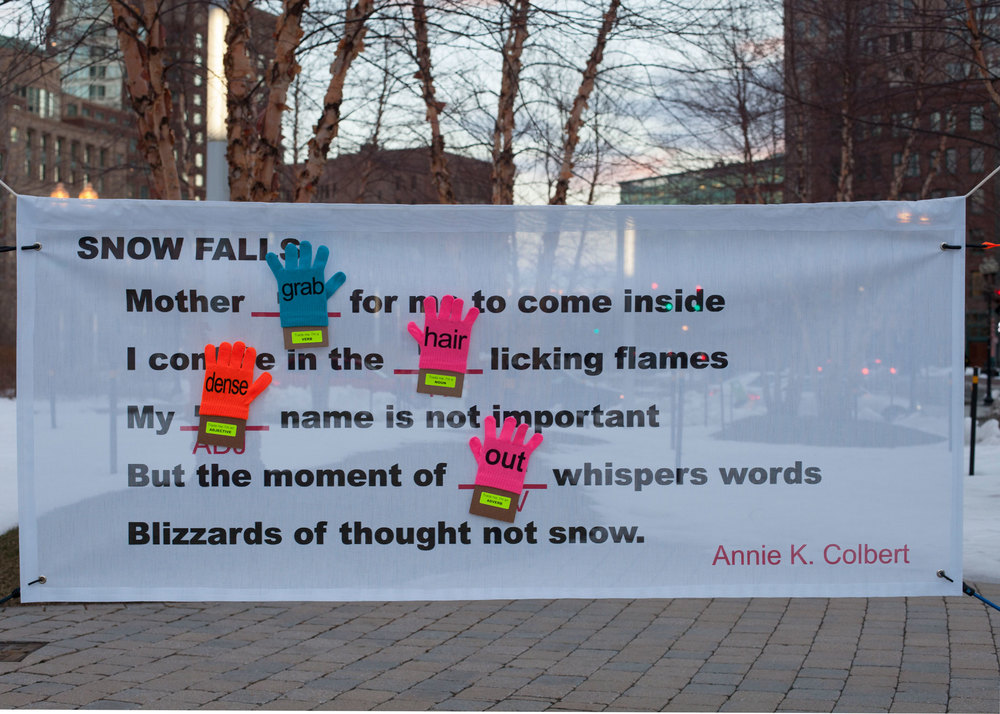
FRIGID PHRASES: a game of outdoor mad libs poetry played with gloves, developed by Kate Gilbert and Emily Lombardo for the Rose Kennedy Greenway, Boston; Feb. 20, 2013

Frigid Phrases was submitted to the Greenway Conservancy’s Winter Lights call for proposals. Though it was rejected as light-based art, we were asked to develop it as an event “to bring warmth and cheer to the Greenway during the darkest part of the year”.


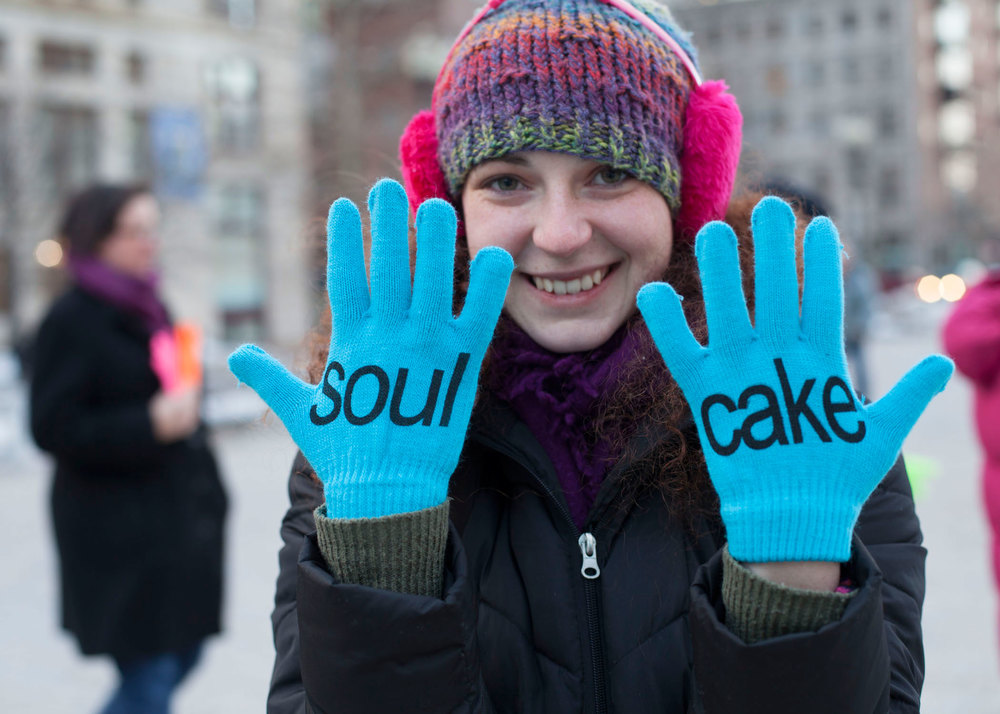
photo: (c) Connie SawyerFrigid Phrases turned out to be aptly named. Despite a wind chill temp in the twenties, approximately 125 people played with us and received free gloves. Participants included international tourists, businessmen, Greenway neighbors, parents and children on school break, artists and faculty from SMFA Boston, the contributing poets, and our hardy friends.


Many were initially unwitting participants, such as the pair of businessmen on their way home, or the family walking by after visiting the New England Aquarium. It gave me great delight when these passersby accepted my invitation to play and later proudly held their gloves saying SOUL CAKE or DENSE MIND.
Lessons learned:
  • There’s something magical about the combination of spontaneous play and free stuff when you’re not expecting it.
  • People like rules when playing a game; too structured and its not fun; without boundaries, we feel uncomfortable.
  • Participation is increased if one can directly affect the outcome of the work; poems were submitted by area-poets and they kept changing each time a participant swapped out a word glove.

FRIGID PHRASES poem during play; photo: (c) Connie Sawyer 

My intent for any work I create, be it event or sculpture, is that it have a life after its first display. Frigid has that potential, whether as a personal memory that one recalls looking down at your gloves, or the collective history that we created on Twitter and continue to create when we're asked, "Why do your gloves say WEARS COLD?"


If you’re interested in continuing the event’s life and hosting Frigid Phrases between now and April, please contact me. We have about 100 pairs of gloves left. We’re also interested in reinterpreting Frigid for warmer climates and seasons.


See FRIGID PHRASES gallery page for more images, the blog for more information on how the game was played. And Tweet us @frigidphrases when you see a pair!


FRIGID PHRASES, a social experiment

FRIGID PHRASES began as a SMFA class exploration into relational aesthetics, the term coined by Nicolas Bourriaud, and subsequent art movements involving the art object's relationship to people in a social context. Emily and I wanted to take this idea beyond the classroom, the galleries and the institution, and out into the real world. The Greenway during school vacation seemed like the ideal testing ground. 


Greenway Wharf District Parks in the late afternoon. Let's add color...and people!We're curious to see what happens with this dynamic social environment we're creating. There's no individual winner. There's no solving the poems. Their meaning will be in constant flux as we trade out word/gloves. Does that frustrate the problem solvers among us?

Will people follow our rules (swap gloves within the poems) or will they set up their own bartering system? Will they take their gloves and split? Or will they stay for a while and share in some tea and conversation? We'll see, and I'll report back here.

FRIGID PHRASES
Wed. Feb. 20
Play anytime between 4 and 6:30
Greenway Wharf Parks

For more information: http://frigidphrases.blogspot.com/