Interpreting the Natural: Contemporary Visions of Scholars' Rocks

Interpreting the Natural: Contemporary Visions of Scholars' Rocks

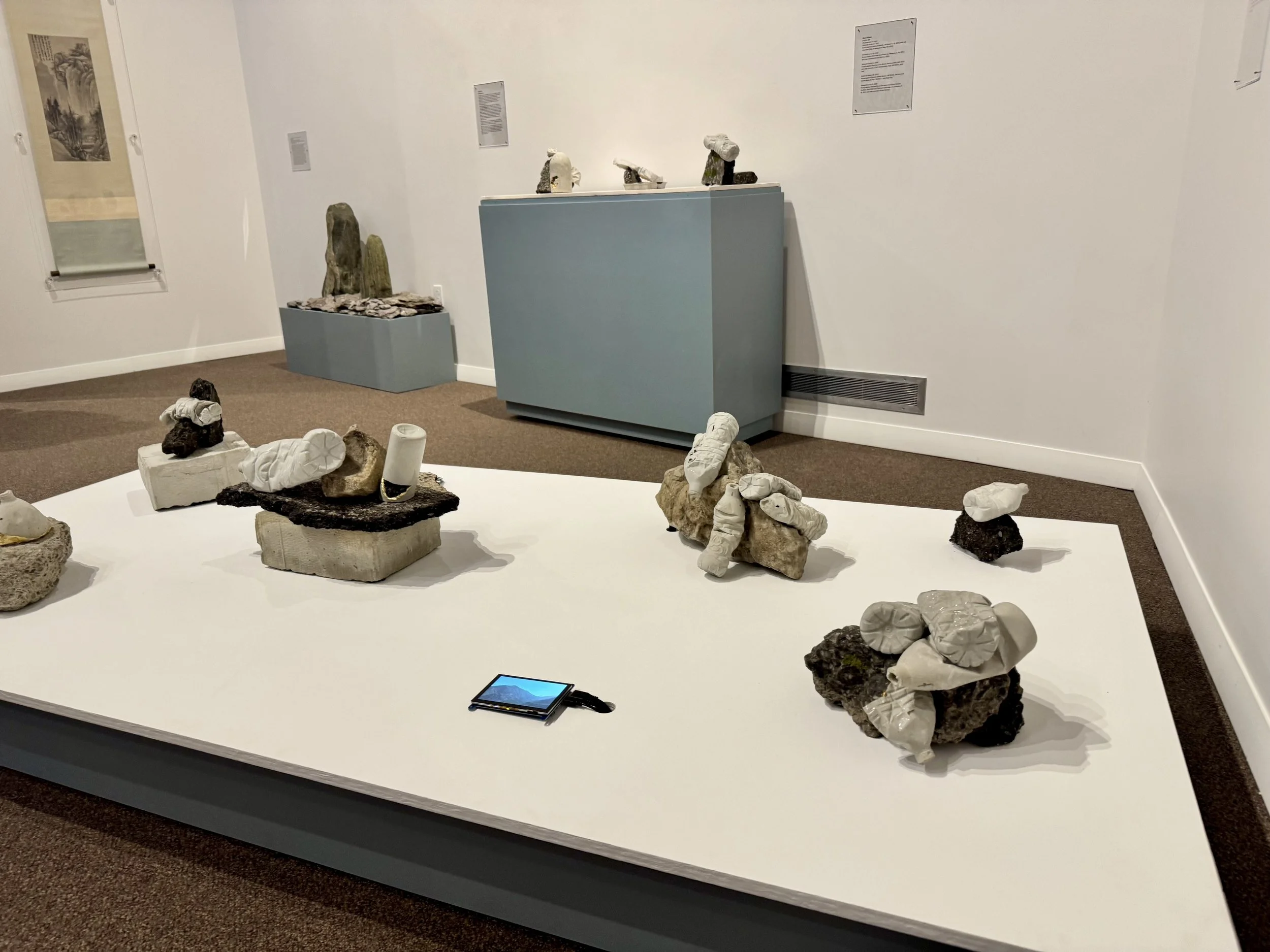
Found/Made is now on view as part of Interpreting the Natural: Contemporary Visions of Scholars' Rocks at Art Museum Complex, Duxbury through January 17, 2027. This group with Paul Harris, Danielle Krcmar, Lisa Tang Liu, Cathy Della Lucia, Andy Moerlein, Wen-hao Tien, Alice Wu, Yu-wen Wu, and Quanzhou Zhao was organized by guest curator Donna Dodson.

Read More

Materials hold the complexity

Materials hold the complexity

The desire to overcomplicate is strong. I’m not sure if it’s innate or trained in me, but I cannot remember a time in my life when my brain wasn’t working on overdrive to find hidden meanings or make multiple connections. Nothing is as it seems. Add to that graduate school training, and the warning never to be “on the nose” and you have an over-complicator.

Yet I’m learning to let materials stand on their own as I prepare for Shift, July 21-September 11 at Bristol Art Museum.

Read More

Outside Perspectives

An excerpt from a blog co-written with Now + There Curator Leah Triplett Harrington after visiting Prospect 5, New Orleans.

Prospect New Orleans, a triennial citywide contemporary art exhibition and the young, scrappy American cousin to more established European exhibitions like documenta and Skulptur Projeckte, recently wrapped its fifth iteration with an exhibition as in flux as these pandemic times.

“Yesterday We Said Tomorrow” was all about the future. As we traversed New Orleans East to Tremé to Bywater and Uptown, the most powerful work we encountered acknowledged the traumas of the past while heralding new futures.

Exploring NOLA by way of the exhibition’s map, we saw how Los Angeles-based curators and Prospect’s co-artistic directors, Diana Nawi and Naomi J. Keith, collaged artists, artworks, and institutions. Their approach was less conductor, more jazz improvisation, embracing the possibilities of unexpected juxtapositions of site context and artistic voice.

Read More

Sunday sculptor, and it's ok.

Sunday sculptor, and it's ok.

I’m comfortable being a Sunday sculptor.

It’s a cathartic hobby. In the same way a weekend warrior depends on [insert extreme sport here] to stay sane, my studio practice enables me to show up as my best self for family, friends, and colleagues. Studio Sundays, or stolen studio mornings before work, are my rudder. Without them, I’m one cranky, anxious bitch.

I made a decision eight years ago not to make studio work my sole pursuit. I could have done it. Life availed herself, beckoning me to swim in the ocean of pure unfettered creativity. But that felt frivolous and lonely.

Read More

The one that got away.

I’m the kind of traveler who has more reading material than shoes in her departing luggage. Returning, I usually have bits of concrete and rock carefully wrapped in scarves and wedged between my never-worn athletic clothes. Whether visiting a new city for public art inspiration or escaping to nature, my trips are spent carefully observing the ground. Terra firma is where I find the most accessible connection to the lands I traverse and the people who inhabit them.

The global pandemic has reminded me that experiences are more meaningful than objects and that taking even the littlest fragment of another peoples’ infrastructure or culture exercises my White Supremacy. And thus, on my first return to the States in 16 months, I had zero souvenirs of the global ubiquitousness of asphalt or concrete.

But boy is possession-in-the-name-of-art a hard habit to break, and I sit here in my cold studio pining for “the one that got away.” Yes, I left a piece of concrete in its natural habitat. Here she is:

The One That Got Away
In her habitat.jpg

I found her on a Caribbean beach. She was a few feet from the water and a few yards from a contemporary condo being meticulously taken apart by locals. Neat piles of floor tiles, timbers piled like Pick Up Sticks, and wires hanging without fixtures suggested people were salvaging every last reusable piece of a once opulent modern-day hacienda. (Don’t get me started on the ratio of dark-skinned staff to light-skinned guests.) I imagine the sea reached “previously unthinkable heights” and came too close for the owner’s comfort. (That or construction has been delayed by years and there’s no concern for the sea’s inland march.)

But this piece, the one that got away, suggests destruction. She was most likely part of a larger sidewalk or exterior surface formed to make the coastal area’s sharp, coral bed less irritating to bare toes. Her grid is too uniform in depth to be an impression left by something on top of her, say tile. And if the surrounding luxury condos indicate this habitat’s function, a “faux tile” would not be appropriate for an interior where shaved coral tiles are the norm. Concrete, after all, is too utilitarian a material.

And this is what I love about using concrete for and in artmaking — making the mundane special.

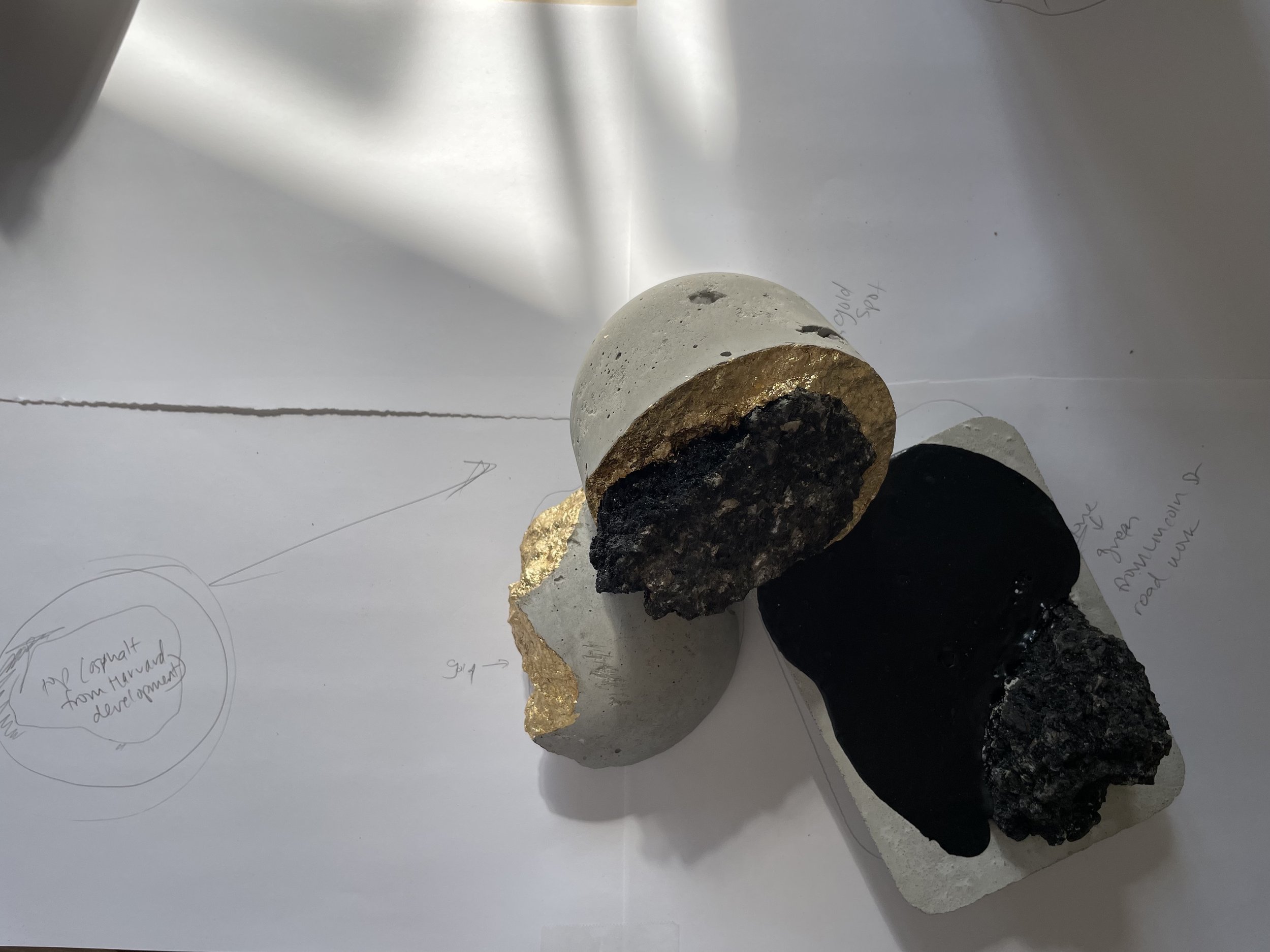
This little gem of a castoff has given me ideas about reclaiming elements from an emergent piece that has been with me since December 2019, informing next steps in the evolution of the Sidewalk Series. Let’s call this work “Tray” for what it was molded from, a catering tray. Tray was my second and last experiment spray painting asphalt. It convincingly demonstrated that silver leaf on asphalt looks like bad tin foil art, and copper on concrete is too trendy. (Might as well make paperweights for a boutique.)

Tray, as a 14”x14” mini materials test site, has also been taunting me to more fully explore concrete and asphalt’s materiality. It is slowly degrading from gravity — it’s on a 45-ish degree angle — and the fluctuating temperature and humidity of a less-than-perfect-climate-controlled art studio. It is falling apart before my eyes. Sort of like everything else on earth.

I keep thinking I’ll smash it up soon and make it into something else. But it seems as long as the pandemic lasts, Tray will serve a purpose as my own terra firma, teaching me, little by little, what I came to the studio to discover.
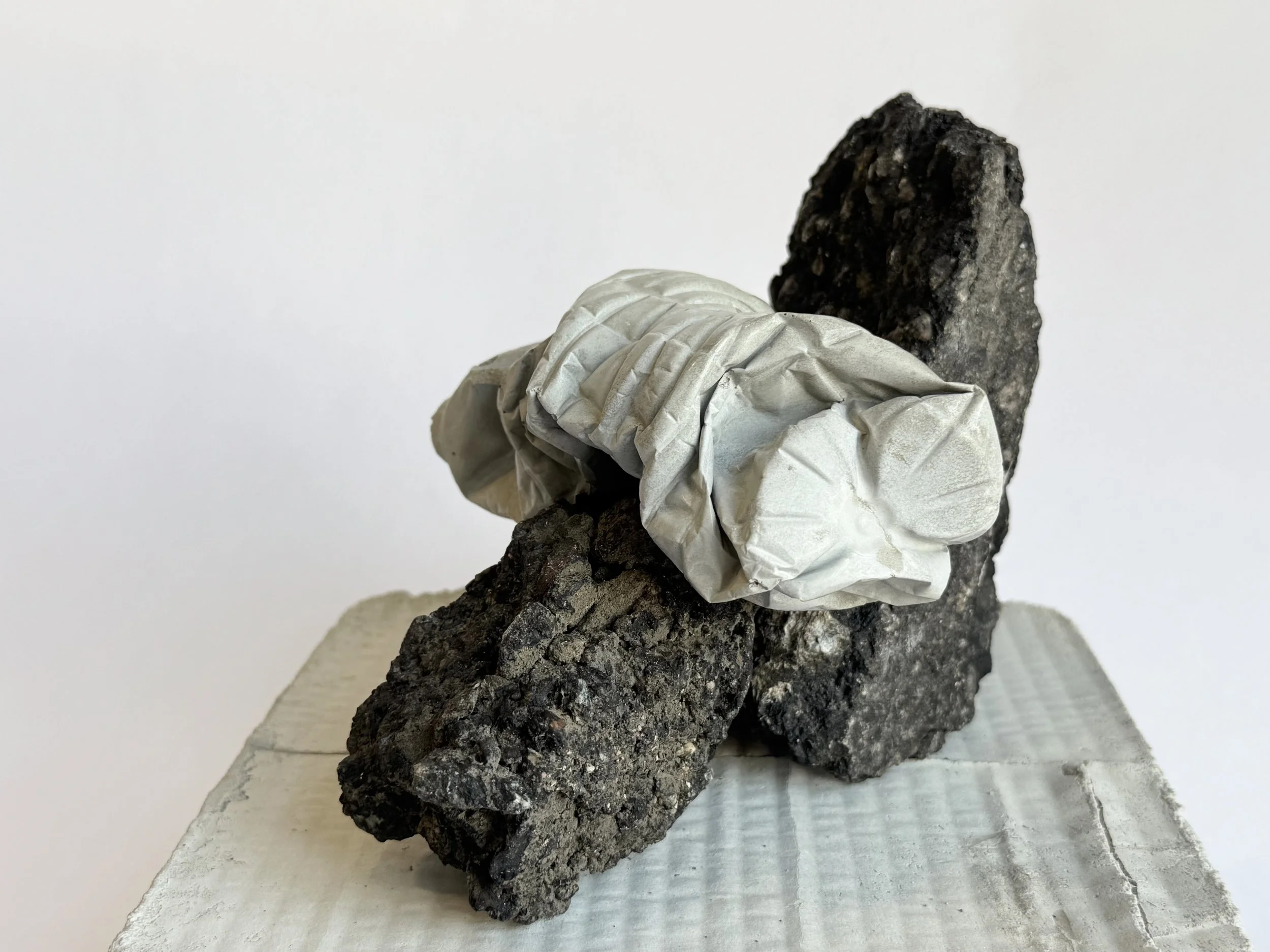
“Tray,” the site of so many failure. Now a mini job-site and attempt to sort and recycle all of the original materials.

“Tray,” the site of so many failure. Now a mini job-site and attempt to sort and recycle all of the original materials.